
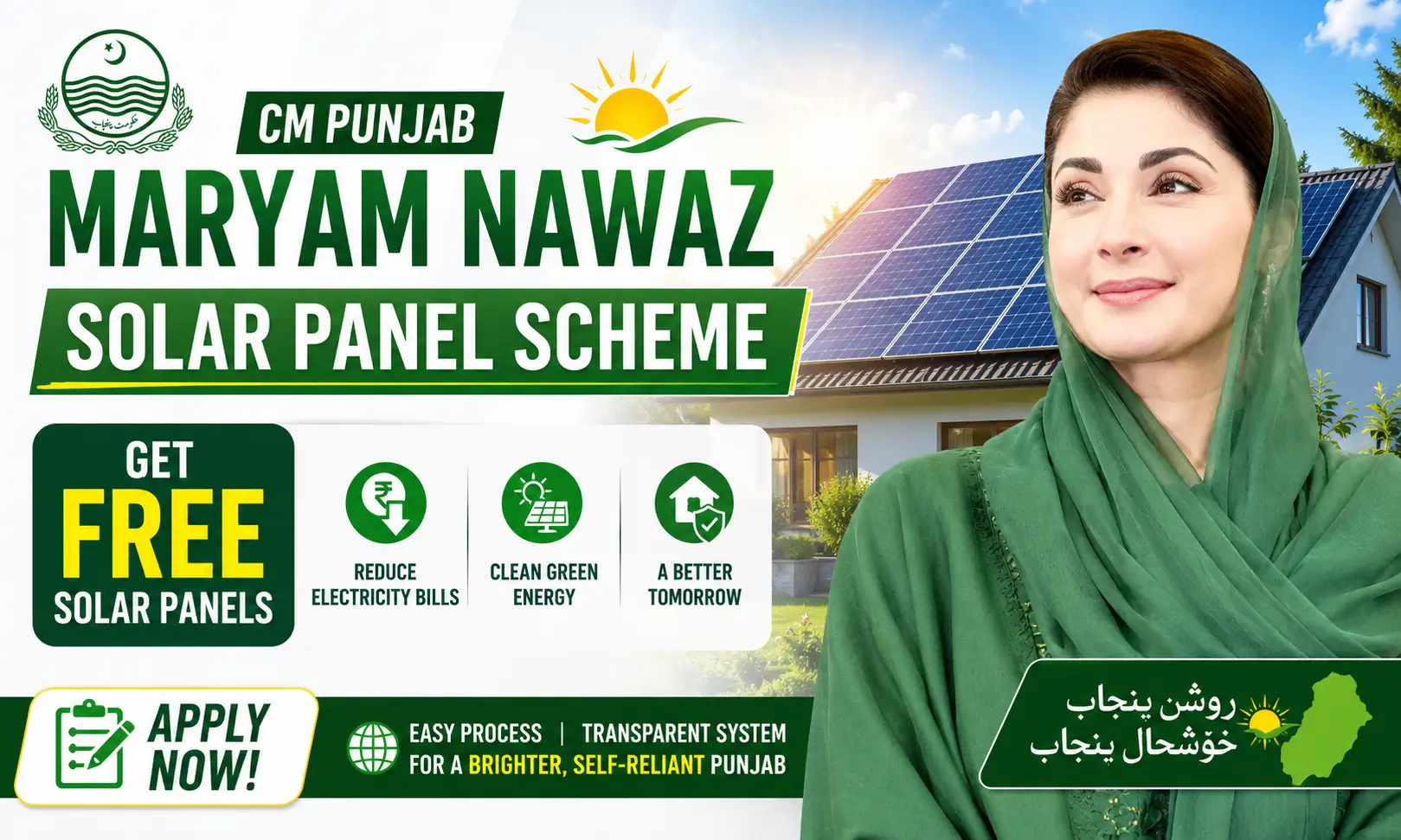
CM Solar Panel Scheme | Free Solar Panels for Punjab
If you’ve been struggling with sky-high electricity bills every month, you’re not alone. Millions of families across Pakistan, especially in Punjab, are caught in a cycle of rising energy costs and unreliable power supply. The good news? The Government of Punjab has launched the CM Solar Panel Scheme, a landmark initiative designed to bring affordable, clean solar energy directly to households that need it most.
This program is more than just a subsidy. It’s part of a broader national push toward renewable energy, aimed at reducing dependence on fossil fuels and easing the electricity crisis that has burdened Pakistani households for years. Under this scheme, eligible low-income families can receive solar panels either free of cost or at heavily subsidized rates, allowing them to generate their own electricity at home.
In this guide, we’ll walk you through everything you need to know, from who qualifies and how to apply to what documents you’ll need, how the installation works, and how much you could actually save on your monthly electricity bill.
What Is the CM Solar Panel Scheme?
The Chief Minister Solar Panel Scheme, commonly referred to as the CM Solar Scheme, is a government-funded solar energy program initiated by the Punjab government. Its primary objective is to provide solar panel systems to low-income households, helping them become partially or fully energy-independent.
The scheme operates under Pakistan’s broader Alternative Energy Development Board (AEDB) framework and aligns with national goals set by NEPRA (National Electric Power Regulatory Authority) for increasing the share of renewable energy in the country’s power mix. Through net metering, beneficiaries can even sell surplus electricity back to the grid — turning their homes into micro power plants.
Key Objectives of the Scheme
- Reduce monthly electricity bills for low-income families
- Promote green energy and reduce carbon emissions across Punjab
- Decrease the load on the national grid and reduce loadshedding pressure
- Accelerate the adoption of solar energy at the household level
- Support Pakistan’s commitment to renewable energy targets
Why This Scheme Matters Right Now
Pakistan’s electricity crisis has reached a breaking point. Average consumers are paying record-high bills, with per-unit costs increasing severalfold in just a few years. WAPDA and distribution companies (DISCOs) are struggling to manage losses, while circular debt in the power sector continues to grow.
For a household earning a modest income, an electricity bill of Rs. 5,000 to Rs. 15,000 per month is a serious financial burden. Solar energy offers a way out, and with the government stepping in to subsidize the cost of solar systems, this technology is now within reach for families who could never afford it on their own.
The CM Solar Panel Scheme directly addresses this pain point by combining government subsidy, technical installation support, and ongoing net metering benefits, a complete package that makes solar adoption practical and immediate.
Also Read: PM Loan Scheme: Apply Now.
Who Is Eligible for the CM Solar Panel Scheme?
Not everyone can apply for this program; it is specifically targeted at households that genuinely need financial assistance with energy costs. The eligibility criteria have been designed to ensure the subsidy reaches the most deserving segments of society.
Eligibility Requirements
| Eligibility Criteria | Details |
| Residency | Must be a permanent resident of Punjab |
| Monthly Electricity Units | Consumption of 100–300 units per month (varies by sub-scheme) |
| CNIC Requirement | Active electricity connection with WAPDA or DISCO is required |
| Income Level | Priority for low-income and lower-middle-income households |
| BISP Beneficiaries | Benazir Income Support Programme recipients get priority |
| Property Ownership | Must own or legally occupy the property where panels are installed |
| Existing Solar | Households without existing solar setup are eligible |
| Bill Status | Households without an existing solar setup are eligible |
Importantly, the scheme specifically targets electricity consumers using 100 to 300 units per month. This bracket represents the lower-middle segment of household electricity consumers, people who need relief the most but are often overlooked by large-scale commercial energy programs.
Who Gets Priority?
- Families registered under the Benazir Income Support Program (BISP)
- Widows and female-headed households
- Families with persons with disabilities
- Residents of rural and semi-urban areas with frequent power outages
- Government school teachers and low-paid government employees
Solar Panel Capacity and System Details
The scheme offers different solar system sizes based on household consumption and eligibility category. Most beneficiaries receive systems in the range of 1 to 5 kilowatts (kW), which is sufficient to power basic household appliances including lights, fans, a refrigerator, and a small air cooler.
| System Size | Monthly Units Covered | Ideal For |
| 1 kW | 80–120 units | Very small households, single room |
| 2 kW | 150–200 units | Small family, 2–3 rooms |
| 3 kW | 250–300 units | Medium household, essential appliances |
| 5 kW | 400–500 units | Larger households with AC usage |
Most beneficiaries under the CM scheme receive a 2kW to 3kW system — enough to significantly cut their monthly electricity consumption from the grid and, in many cases, eliminate the bill almost entirely during peak sunlight months.
Government Subsidy: How Much Does the Government Pay?
One of the most common questions people ask is: ‘Do I have to pay anything?’ The answer depends on your eligibility category.
Under the CM Solar Panel Scheme, the Punjab government subsidizes a significant portion and, in some cases, the full cost of the solar system. For the most vulnerable families (particularly BISP beneficiaries), the system may be provided free of charge. For other eligible households, a small co-payment or easy installment plan may apply.
Subsidy Overview
- BISP Registered Families: 100% subsidy (fully free solar installation).
- Low-Income Non-BISP Households: 70–90% subsidy; remaining payable in easy installments.
- Lower-Middle Income Households: 50–60% subsidy with flexible repayment options.
The government covers installation costs, wiring, inverters, and battery storage units as part of the package. This is a turn-key solution; the beneficiary does not need to source any components separately.
Required Documents for Application
Before applying, make sure you have all the required documents ready. Incomplete applications are one of the most common reasons for rejection or delays. Here’s everything you’ll typically need:
- Original and photocopy of CNIC (Computerized National Identity Card)
- Recent electricity bill (not more than 3 months old) from WAPDA or your DISCO
- Proof of property ownership (e.g., registry, mutation, or rent agreement)
- Recent passport-size photographs (usually 2–4 copies)
- BISP beneficiary card or certificate (if applicable)
- Mobile number registered under your CNIC
- Bank account details (for subsidy disbursement if applicable)
- Domicile certificate confirming Punjab residency
It’s strongly recommended to keep digital copies (photos or scans) of all documents. Some online portals may require you to upload these during registration.
Also Read: CM Punjab Bewa Sahara Card 2026 Apply Online.
How to Register: Step-by-Step Application Process
The registration process for the CM Solar Panel Scheme has been designed to be accessible even for people with limited digital literacy. Both online and in-person registration options are available.
Online Registration Method
- Visit the official Punjab Government solar scheme portal or the Punjab Information Technology Board (PITB) website
- Create an account using your CNIC number and mobile phone number
- Fill in the application form with your personal details, electricity bill reference number, and household information
- Upload scanned copies or clear photographs of all required documents
- Submit the application and save the reference/tracking number provided
- Wait for an SMS confirmation on your registered mobile number
In-Person Registration Method
- Visit your nearest Union Council office, Tehsil Headquarters, or designated government facilitation center
- Collect the official application form (available free of charge)
- Fill in all required fields carefully in Urdu or English as instructed
- Attach photocopies of all required documents
- Submit the form to the designated officer and collect your acknowledgment slip
- Keep the acknowledgment slip safe for future reference and tracking
Many applicants prefer the in-person method because local government staff can help with form-filling, especially for elderly applicants or those unfamiliar with online processes.
Balloting Process: How Are Beneficiaries Selected?
Because the number of applications typically far exceeds the available solar panel units in each phase, the Punjab government uses a transparent balloting (lottery) system to select beneficiaries.
The balloting is conducted openly and is often streamed live or announced publicly to ensure fairness and transparency. Priority weighting is given to BISP families, female-headed households, and applicants from underserved districts.
Balloting Timeline
- Applications are collected over a defined period (usually 30–60 days per phase)
- Data verification is done by cross-checking CNIC with NADRA and electricity bills with DISCOs
- Balloting takes place at the provincial level under supervision
- Results are announced via SMS, the official portal, and local media
- Selected beneficiaries are contacted for installation scheduling
If you are not selected in one phase, your application may remain active for consideration in the next phase, so it’s worth applying early and keeping your documents up to date.
Solar Panel Installation
Once selected, the installation process is handled by government-approved solar companies and contractors. You don’t need to find a vendor yourself; the scheme covers everything from supply to installation.
Installation Steps
- A technical team visits your home for a site assessment
- They evaluate your roof’s orientation, size, and structural condition
- The solar panels, inverter, and battery (if included) are delivered to your home
- Professional installation is typically completed within 1–2 days
- Electrical wiring and net meter connection are completed
- The system is tested and handed over with a user demonstration
- An installation certificate is issued to the homeowner
Most systems come with a manufacturer’s warranty of 10 to 25 years on panels and 2 to 5 years on inverters. The government scheme may also include a limited maintenance support period.
Net Metering
One of the most powerful features of a grid-connected solar system is net metering, a billing mechanism that allows you to send excess electricity back to the national grid and receive a credit on your bill.
Under NEPRA’s net metering regulations, any licensed electricity consumer with a solar system can apply for net metering. This means that during the day, when your solar panels produce more electricity than your home needs, the surplus flows back to WAPDA’s grid, and your meter literally runs backwards, reducing your bill.
Net Metering Benefits at a Glance
- Earn electricity credits for every unit you export to the grid
- Your monthly bill is calculated based on net consumption (units used minus units exported)
- Some months your bill could be zero or even show a credit balance
- Helps recover the cost of your solar investment faster
- Supports national grid stability and reduces pressure on power plants
The net metering application is submitted to your DISCO (LESCO, FESCO, MEPCO, GEPCO, etc.) after installation, and approval typically takes 30 to 90 days. The government scheme assists beneficiaries in completing this process.
How Much Can You Save on Your Electricity Bill?
This is the question everyone wants answered. The savings depend on your current consumption, your system size, and the amount of sunlight your location receives. Pakistan, especially Punjab, is blessed with abundant sunshine for most of the year, making solar a highly effective solution.
| Current Monthly Bill | System Size Installed | Estimated Monthly Saving |
| Rs. 3,000–5,000 | 1–2 kW | Rs. 2,000–4,000 |
| Rs. 6,000–10,000 | 2–3 kW | Rs. 4,500–8,000 |
| Rs. 10,000–18,000 | 3–5 kW | Rs. 7,000–15,000 |
| Rs. 18,000+ | 5 kW+ | Rs. 12,000–18,000+ |
These are estimated figures based on average solar irradiance in Punjab. Actual savings will vary based on the specific location, season, and household usage patterns. However, most beneficiaries report recovering the residual cost (if any) of their solar system within 2 to 4 years through bill savings alone.
Environmental Impact
Beyond the financial benefits, the CM Solar Panel Scheme contributes to a cleaner environment. Pakistan is among the countries most vulnerable to climate change, and every household that switches to solar reduces its carbon footprint significantly.
- A 3kW solar system can offset approximately 1.5 to 2 tonnes of CO2 per year
- Solar energy produces no air pollution during operation
- Reducing fossil fuel dependency lowers Pakistan’s energy import bill
- Mass adoption of solar panels contributes to achieving Pakistan’s NDC (Nationally Determined Contributions) under the Paris Agreement
- Clean energy at the household level contributes to Punjab’s green growth agenda
When thousands of homes across Punjab generate their own clean electricity, the cumulative effect on air quality, energy security, and greenhouse gas emissions is substantial, making this not just a subsidy program but a genuine contribution to Pakistan’s environmental future.
Common Mistakes
Many applicants lose their chance at this scheme not because they are ineligible, but because of avoidable errors during the application process. Here are the most common mistakes and how to avoid them:
- When submitting blurry or unclear document photographs, always use good lighting and ensure text is legible
- Providing a mobile number not registered under your CNIC, use your actual registered number
- Submit an old electricity bill, making sure the bill is within the last 90 days
- Applying with a CNIC that has expired, renew your CNIC through NADRA before applying
- Not matching the address on documents, your CNIC address, electricity bill address, and application address should all match
- Applying multiple times from the same household, only one application per connection is allowed
- Providing an incorrect electricity meter number, double-check the reference number on your bill
- Missing the application deadline, check the official portal regularly for phase announcements
Punjab Government’s Solar and Energy Initiatives
The CM Solar Panel Scheme does not stand alone it is part of a comprehensive renewable energy policy being pursued by the Government of Punjab. Several complementary programs run alongside it:
- Rooftop Solar Program for government schools and hospitals
- Solar-powered tube well initiative for farmers in agricultural zones
- PM’s Solar Panel Initiative for low-income households at the federal level
- AEDB’s solar village electrification projects in off-grid areas
- Punjab Green Energy Policy promotes industrial solar adoption
Together, these initiatives represent a coordinated effort to transform Punjab’s energy landscape from fossil-fuel dependent to solar-powered, making Pakistan one of South Asia’s fastest-growing solar markets.
Scheme Updates, New Phases, and Application Deadlines
The CM Solar Panel Scheme is rolled out in phases. Each phase has a defined application window, a set number of beneficiaries, and specific districts or regions it targets. It’s important to stay up to date because missing a phase means waiting for the next one.
How to Stay Updated
- Follow the official Punjab Government website and social media pages
- Monitor the PITB (Punjab Information Technology Board) portal for announcements
- Subscribe to SMS alerts by registering your number on the scheme portal
- Check local union council noticeboards for phase announcements in your area
- Follow reputable Pakistani news sources for scheme updates
As of the latest available information, the scheme continues to expand its reach with each new phase, covering additional districts and increasing the total number of beneficiary households. Always verify deadlines directly from official government sources to avoid acting on outdated information.
Conclusion
The CM Solar Panel Scheme is one of the most significant social welfare and clean energy initiatives launched in Punjab in recent years. At a time when electricity bills are pushing families to the brink, this program offers real, tangible relief — and a path toward lasting energy independence.
Whether you’re a BISP beneficiary hoping for a fully free installation, or a working-class family looking to slash your monthly electricity costs, this scheme is worth your serious attention. The process is straightforward, the benefits are substantial, and the long-term impact on your household budget can be life-changing.
Apply as early as possible in each phase. Keep your documents ready. Stay informed through official channels. And take this step not just for your family’s financial wellbeing, but as a contribution to a cleaner, greener Pakistan.